Antropología Jurídica Antigua
Palabras clave:
AntropologíaSinopsis
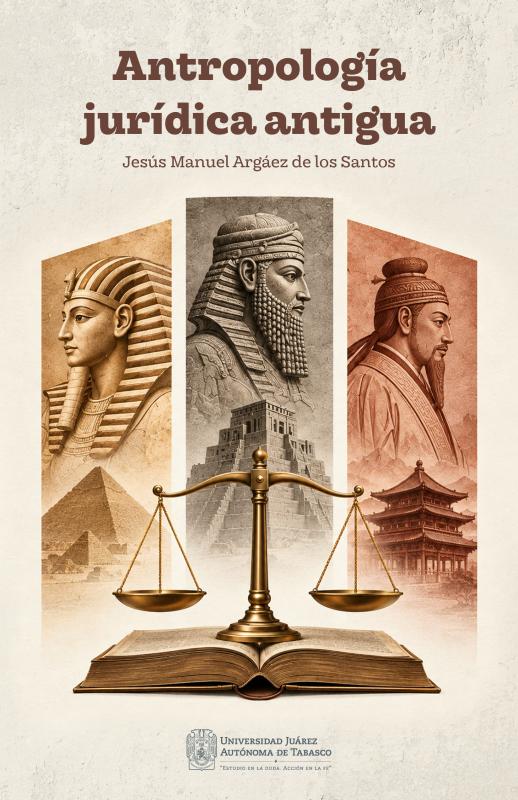
La obra aborda la antropología jurídica como una disciplina que estudia el derecho desde su dimensión social y cultural, entendiendo las normas, las instituciones y las prácticas de justicia como construcciones históricas vinculadas con la organización social, las relaciones de poder, las creencias y las condiciones económicas de cada sociedad. Desde esta perspectiva, el derecho no es un fenómeno exclusivamente técnico ni propio de las sociedades occidentales modernas, pues diversas comunidades desarrollaron sistemas normativos y mecanismos de resolución de conflictos antes de la escritura y la formación del Estado.
La obra también examina las primeras expresiones jurídicas de civilizaciones como Mesopotamia, Egipto y China, mostrando las distintas relaciones entre derecho, religión, autoridad y organización política. Finalmente, destaca la importancia del pluralismo jurídico y de los derechos humanos para reconocer la diversidad cultural y las distintas concepciones de justicia.
Descargas
Referencias
Acosta, X. (2006). Sociología del conocimiento y de la cultura: Tradiciones en la teoría social. Tirant lo Blanch.
Adamek, P. (2015). A good son is sad if he hears the name of his father: The tabooing of names in China as a way of implementing social values. Routledge.
Alkadry, M. G. (2002). Bureaucracy: Weber's or Hammurabi's? Ideal or ancient? Public Administration Quarterly, 26(3), 317–345.
Al-Shamari, M. Kh. J., & Al-Jalili, M. (2020). Two Old Babylonian marriage contracts from Isin. Iraq, 82, 125–137. https://doi.org/10.1017/irq.2020.5
Altman, A. (2012). Tracing the earliest recorded concepts of international law: The ancient Near East (2500–330 BCE).
Allam, S. (1991). Egyptian law courts in Pharaonic and Hellenistic times. The Journal of Egyptian Archaeology, 77, 109–127. doi.org
Allam, S. (2001). Slaves. In D. B. Redford (Ed.), The Oxford encyclopedia of ancient Egypt (Vol. 3, pp. 293–296). Oxford University Press.
Allam, S. (2001). Slaves. In D. B. Redford (Ed.), The Oxford encyclopedia of ancient Egypt (Vol. 3, pp. 293–296). Oxford University Press.
Ando, C., & Richardson, S. (Eds.). (2017). Ancient states and infrastructural power: Europe, Asia, and America. University of Pennsylvania Press.
Assmann, J. (1989). State and religion in the New Kingdom. En W. K. Simpson (Ed.), Religion and philosophy in Ancient Egypt (pp. 55–88). Yale Egyptological Seminar.
Baber, R. E. (1934). Marriage in Ancient China. The Journal of Educational Sociology, 8(3), 131–140.
Baldó Lacomba, M. (2013). El saber histórico. Tirant Humanidades.
Bárcena Arévalo, E. (2021). El impacto de la reforma de derechos humanos en el Poder Judicial de la Federación: Una lectura desde la antropología jurídica. En N. González Martín, C. M. Pelayo Moller, y G. E. Estrada Adán (Coords.), Las reformas constitucionales de amparo y derechos humanos de junio de 2011 (Serie Opiniones Técnicas sobre Temas de Relevancia Nacional, Núm. 44, pp. 31–37). Instituto de Investigaciones Jurídicas, UNAM.
Barjamovic, G. (2013). Mesopotamian empires. En P. F. Bang y W. Scheidel (Eds.), The Oxford handbook of the state in the ancient Near East and Mediterranean (pp. 120–160). Oxford University Press.
Barmash, P. (2008). Scribal initiative in the clarification and interpretation of Mesopotamian law collections. En C. Cohen, V. A. Hurowitz, A. M. Hurvitz, Y. Muffs, B. J. Schwartz, y J. H. Tigay (Eds.), Birkat Shalom: Studies in the Bible, ancient Near Eastern literature, and postbiblical Judaism presented to Shalom M. Paul on the occasion of his seventieth birthday (Vol. 2, pp. 551–563).
Barmash, P. (2015). En B. A. Strawn (Ed.), The Oxford encyclopedia of the Bible and law (Vol. 1, pp. [páginas de la entrada]). Oxford University Press.
Barnard, A. (2008). The co-evolution of language and kinship. En N. J. Allen, H. Callan, R. Dunbar, y W. James (Eds.), Early human kinship: From sex to social reproduction (pp. 232–243). Wiley-Blackwell. doi.org
Barnard, A. (2012). Genesis of symbolic thought. Cambridge University Press.
Barnard, A. (2014). Defining hunter-gatherers: Enlightenment, Romantic, and social evolutionary perspectives. En V. Cummings, P. Jordan, y M. Zvelebil (Eds.), The Oxford handbook of the archaeology and anthropology of hunter-gatherers (pp. 43–54). Oxford University Press. doi.org
Barnard, A. (2016). Language in prehistory. Cambridge University Press. doi.org
Barnard, A. (2021). History and theory in anthropology (2.ª ed.). Cambridge University Press. https://doi.org/10.1017/9781108936620
Barnard, A., & Spencer, J. (Eds.). (2010). The Routledge Encyclopedia of Social and Cultural Anthropology (2.ª ed.). Routledge.
Bárta, M. (2013). Kings, viziers and courtiers: Executive power in the Third millennium B.C. En J. C. Moreno García (Ed.), Ancient Egyptian Administration (pp. 153–175). Brill.
Bárta, M. (2020). Egypt's Old Kingdom: A view from within. En K. Radner, N. Moeller, y D. T. Potts (Eds.), The Oxford history of the ancient Near East: Volume 1: From the beginnings to Old Kingdom Egypt and the Dynasty of Akkad (pp. 163–244). Oxford University Press.
Bárta, M. (2020). Egypt's Old Kingdom: A view from within. In K. Radner, N. Moeller, & D. T. Potts (Eds.), The Oxford history of the ancient Near East: Volume 1: From the beginnings to Old Kingdom Egypt and the dynasty of Akkad (pp. [Page numbers]). Oxford University Press.
Bastide, R. (1977). Antropología aplicada. Amorrortu Editores.
Bauschatz, J. (2013). Law and enforcement in Ptolemaic Egypt. Cambridge University Press. doi.org
Bayoumy, T. F. (2022). Oracular Gods in Ancient Egypt. Journal of Association of Arab Universities for Tourism and Hospitality, 22(2), 1–19.
Beaux, N. (1991). Ennemis étrangers et malfaiteurs égyptiens: La signification du châtiment au pilori. Bulletin de l'Institut Français d'Archéologie Orientale, 91, 33–53. egnet.net
Bederman, D. J. (2004). International law in antiquity. Cambridge University Press.
Berkshire Publishing Group. (2009). Shang dynasty. In Berkshire encyclopedia of China: Modern and historic views (Vol. 4, pp. 1957–1961). Berkshire Publishing Group.
Berti, R. (2016). Victim-offender reconciliation in the People's Republic of China and Taiwan. Palgrave Macmillan. doi.org
Bertman, S. (2003). Handbook to life in ancient Mesopotamia. Facts on File.
Boas, F. (1974). The shaping of American anthropology, 1883–1911: A Franz Boas reader (G. W. Stocking Jr., Ed.). Basic Books.
Bodde, D. y Clarence, M. (1967). Law in imperial China: Exemplified by 190 Ch'ing dynasty cases with historical, social, and juridical commentaries. Harvard University Press.
Bottéro, J. (1995). Mesopotamia: Writing, reasoning, and the gods. University of Chicago Press.
Bowman, A. K. y Rathbone, D. (1992). Cities and administration in Roman Egypt. The Journal of Roman Studies, 82, 107–127. doi.org
Budge, E. A. W. (2016). Ancient Egyptian Book of the Dead: Prayers, incantations, and other texts from the Book of the Dead (E. Wilson, Ed.). Wellfleet Press.
Bunge, M. (1999). Las ciencias sociales en discusión: Una perspectiva filosófica. Editorial Sudamericana.
Cairns, H. (1931). Law and anthropology. Columbia Law Review, 31(1), 42–55. doi.org.
Caldwell, E. (2014). Social change and written law in early Chinese legal thought. Law and History Review, 32(1), 1–30. https://doi.org/10.1017/S0738248013000606
Canfield, M. (2023). The anthropology of legal form: Ethnographic contributions to the study of transnational law. Law & Social Inquiry, 48(1), 31–47. doi.org.
Cao, D. (2017). Chinese language in law: Code red. Lexington Books.
Cao, D. (2023). Terminological features of the Chinese legal language. En Ł. Biel y H. J. Kockaert (Eds.), Handbook of terminology: Vol. 3. Legal terminology (pp. 311–326). John Benjamins Publishing Company. doi.org
Claramonte Sanz, V. (2016). Introducción a la antropología. Tirant lo Blanch.
Conley, J. M., & O'Barr, W. M. (1993). Legal anthropology comes home: A brief history of the ethnographic study of law. Loyola of Los Angeles Law Review, 27(1), 41–64. https://digitalcommons.lmu.edu/llr/vol27/iss1/4
Cook, C. A. (1995). Scribes, cooks, and artisans: Breaking Zhou tradition. Early China, 20, 241–277.
Coronel Rivera, Y. (2023). Antropología Jurídica. En R. Contreras Bustamante y J. de la Fuente Rodríguez (Coords.), Diccionario Jurídico (2ª ed.). Tirant lo Blanch.
Creel, H. G. (1970). The origins of statecraft in China: Vol. 1. The Western Chou Empire. University of Chicago Press.
Creel, H. G. (1980). Legal institutions and procedures during the Chou dynasty. En J. A. Cohen, R. R. Edwards y F. C. Chang Chen (Eds.), Essays on China's legal tradition (pp. 26–55). Princeton University Press.
Cunliffe, B., Gosden, C., & Joyce, R. A. (Eds.). (2009). The Oxford Handbook of Archaeology**. Oxford University Press.
Chang, H.-L. (2010). Ancient Chinese concept of fa (law) and its orthographical representations. Chinese Semiotic Studies, 4(2), 114–131. https://doi.org/10.1515/css-2010-0206
Chang, K.-C. (1980). Shang civilization. Yale University Press.
Chao, L. (1982). The socio-political systems of the Shang dynasty. Institute of the Three Principles of the People, Academia Sinica.
Charpin, D. (1995). The history of ancient Mesopotamia: An overview. En J. M. Sasson (Ed.), Civilizations of the ancient Near East (Vol. 2, pp. 807–820). Charles Scribner's Sons.
Charpin, D. (2010). Writing, law, and kingship in Old Babylonian Mesopotamia (J. M. Todd, Trad.). University of Chicago Press.
Charpin, D. (2010). Writing, law, and kingship in Old Babylonian Mesopotamia. University of Chicago Press.
Charpin, D. (2012). Hammurabi of Babylon. I.B. Tauris.Charpin, D. (2012). Hammurabi of Babylon. I.B. Tauris.
Cheng, L. (Ed.). (2009). Shang dynasty. En Berkshire encyclopedia of China (Vol. 1, pp. 1957–1961). Berkshire Publishing Group.
Cheyette, F. L. (1978). The invention of the state. En R. Sullivan (Ed.), Essays in medieval civilization (pp. 143–178). University of Texas Press.
Dandamayev, M. A. (1999). Achaemenid imperial policies and provincial governments. Iranica Antiqua, 34, 269–282.
Darling, L. T. (2013). A history of social justice and political power in the Middle East: The circle of justice from Mesopotamia to globalization. Routledge.
David, R. (2007). Handbook to life in ancient Egypt (2ª ed.). Oxford University Press.
Démare-Lafont, S. (2003). Middle Assyrian period. In R. Westbrook (Ed.), A history of ancient Near Eastern law (Vol. 1, pp. 521–563). Brill.
Démare-Lafont, S. (2011). Judicial decision-making: Judges and arbitrators. In K. Radner & E. Robson (Eds.), The Oxford handbook of cuneiform culture (pp. 335–357). Oxford University Press.
Démare-Lafont, S. (2016). Women at work in Mesopotamia: An attempt at a legal perspective. En B. Lion y C. Michel (Eds.), The role of women in work and society in the Ancient Near East (pp. 351–362). De Gruyter.
Démare-Lafont, S. (2020). Judicial decision-making: Judges and arbitrators. En K. Radner (Ed.), The Oxford Handbook of Cuneiform Culture (pp. 335–351). Oxford University Press.
Démare-Lafont, S. y Fleming, D. E. (Eds.). (2023). Judicial decisions in the ancient Near East. SBL Press Writings from the Ancient World.
Démare-Lafont, S., & Fleming, D. E. (2023). Judicial decisions in the ancient Near East. SBL Press.
Diakonoff, I. M. (Ed.). (1991). Early antiquity (A. Kirjanov, Trad.). University of Chicago Press.
Diamond, S. (1973). The rule of law versus the order of custom. En D. Black y M. Mileski (Eds.), The social organization of law (pp. 318–343). Seminar Press UW Law Repository.
Doak, B. R. (2006). The origins of social justice in the ancient Mesopotamian religious traditions. Faculty Publications - George Fox School of Theology, 185. https://digitalcommons.georgefox.edu/ccs/185
Dong, X., y Li, Y. (2025). La familia jurídica china y la modernización del estado de derecho en China . Springer Nature Singapur.
Driver, G. R., y Miles, J. C. (1960). The Babylonian laws (Vol. 1). Oxford Clarendon Press.
Ellickson, R. C., y Thorland, C. D. (1995). Ancient land law: Mesopotamia, Egypt, Israel. Chicago-Kent Law Review, 71(1), 321–411.
Erdoğan, N. (2024). The God Šamaš with His Political and Social Aspects in Ancient Mesopotamia. OANNES - International Journal of Ancient History, 6(1), 275–298. https://doi.org/10.33469/oannes.1415323
Evans, G. (1958). Ancient Mesopotamian assemblies. Journal of the American Oriental Society, 78(1), 1–11.
Everest-Phillips, M. (2019). Lessons from Lagash: Public service at the start of history and now. En A. Baimenov y P. Liverakos (Eds.), Public service excellence in the 21st century (pp. 53–104). Palgrave Macmillan. doi.org
Eyre, C. (2013). The use of documents in pharaonic Egypt. Oxford University Press.
Fijałkowska, L. (2022). At the Dawn of Legal History: Teaching Law in Ancient Mesopotamia. Acta Universitatis Lodziensis. Folia Iuridica, 99, 51–63. doi.org
Foster, B. R., y Foster, K. P. (2011). Las civilizaciones antiguas de Mesopotamia. Crítica.
Gai, M. (2004). A Re-Examination of the Inheritance System of the Zhou Dynasty. Journal of Beijing Institute of Technology (Social Sciences Edition), (4), 74–77.
Galán Allué, J. M. (2009). El Reino Nuevo I: La construcción del imperio. En J. M. Parra Ortiz (Coord.), El antiguo Egipto: Sociedad, economía y política (pp. 301–388). Marcial Pons.
Galeano Gasca, E. N., y Juárez Ortiz, G. I. (2017). Dossier “Antropología jurídica: reflexiones sobre justicias locales y derechos universales”. Boletín de Antropología, 32(53), 13–17. https://doi.org/10.17533/udea.boan.v32n53a02
Gándara Vázquez, M. (2019). [Título del capítulo aquí]. En B. Cottom (Coord.), La política pública de la cultura (p. 200). El Colegio Nacional; Tirant Lo Blanch.
Gard, D. H. (1957). Power for Life: The Rise of Organized Law in Mesopotamia and its Bearing Upon the Mosaic Book of the Covenant. Interpretation: A Journal of Bible and Theology, 11(1), 45–56. https://doi.org/10.1177/002096435701100103
Glassman, R. M. (2017). The origins of democracy in tribes, city-states and nation-states. Springer. doi.org
Goedicke, H. (1970). Die privaten Rechtsinschriften aus dem Alten Reich. Notring.
Goody, J. (1986). The logic of writing and the organization of society. Cambridge University Press.
Greengus, S. (1969). The Old Babylonian Marriage Contract. Journal of the American Oriental Society, 89(3), 505–532. doi.org
Greengus, S. (1995). Legal and social institutions of ancient Mesopotamia. En J. M. Sasson (Ed.), Civilizations of the ancient Near East (Vol. 1, pp. 469–484). Charles Scribner's Sons.
Haldar, A. (1972). Mesopotamia: myth and reality. Scripta Instituti Donneriani Aboensis, 6, 31–44. https://doi.org/10.30674/scripta.67068
Hawk, B. E. (2015). Law and commerce in pre-industrial societies. Brill Nijhoff.
Holtz, S. E. (2008). The career of a Neo-Babylonian court scribe. Journal of Cuneiform Studies, 60(1), 81–85. https://repository.yu.edu/server/api/core/bitstreams/5450aed2-d24d-4727-92b0-4774d4e02561/content
Holtz, S. E. (2014). Neo-Babylonian trial records. Society of Biblical Literature.
Hucker, C. O. (1975). China's imperial past: An introduction to Chinese history and culture. Stanford University Press.
Humfress, C., Ibbetson, D. y Olivelle, P. (Eds.). (2024). Cambridge comparative history of ancient law. Cambridge University Press.
Hung, A. H.-C. (2024). The unaesthetic complexity of the image of Xiezhi in representing the jurisprudence in ancient and modern China. En K. Zeidler y J. Kamień (Eds.), Aesthetics of law: From methodology to manifestations (pp. 277–294).
Jacobsen, T. (1943). Primitive democracy in Ancient Mesopotamia. Journal of Near Eastern Studies, 3 (2), 159-172.
Jacobsen, T. (1957). Early political development in Mesopotamia. Zeitschrift für Assyriologie, 52(1), 91–140. https://doi.org/10.1515/zava.1957.52.1.91
Janák, J. (2023). The judgment. En R. Lucarelli & M. A. Stadler (Eds.), The Oxford Handbook of the Egyptian Book of the Dead (pp. 393–420). Oxford University Press.
Jany, J. (2020). Legal traditions in Asia: History, concepts and laws.
Jaramillo Uribe, J. M. (2009). Estructuralismo francés y estructuralismo metateórico. Discusiones Filosóficas, 10(15), 23–50. https://revistasojs.ucaldas.edu.co/index.php/discusionesfilosoficas/article/view/660
Jördens, A. (2012). Government, taxation, and law. En C. Riggs (Ed.), The Oxford Handbook of Roman Egypt (pp. 56–67). Oxford University Press.
Kar, R. B. (2012). Western legal prehistory: Reconstructing the hidden origins of Western law and civilization. University of Illinois Law Review, 2012(5), 1559–1710. illinoislawreview.org
Karlgren, B. (1948). Glosses on the Book of Documents (Vol. 2). Museum of Far Eastern Antiquities.
Kelly, B. (2011). Petitions, litigation, and social control in Roman Egypt. Oxford University Press.
Kemp, B. J. (2016). El antiguo Egipto: Tres mil años de historia. Editorial Crítica.
Kern, M. (2007). The performance of writing in western Zhou China. En S. La Porta & D. Shulman (Eds.), The Poetics of Grammar and the Metaphysics of Sonda and Sign (pp. 109–175). Brill.
Kern, M. (2010). Offices of writing and reading in the Rituals of Zhou. En B. A. Elman & M. Kern (Eds.), Statecraft and Classical Learning: The Rituals of Zhou in East Asian History (pp. 64–93).
Kluckhohn, C. (1965). Antropología. Fondo de Cultura Económica.
Knight, C. (2008). Language co-evolved with the rule of law. Mind & Society, 7(1), 109–128. doi.org
Kornfeld, I. E. (2009). Mesopotamia: A history of water and law. En J. W. Dellapenna & J. Gupta (Eds.), The Evolution of the Law and Politics of Water (pp. 21–36).
Kramer, S. N. (1953). The oldest laws. Scientific American, 188(1), 26–28. https://doi.org/10.1038/scientificamerican0153-26
Krotz, E. (2002). Antropología jurídica: Perspectivas socioculturales en el estudio del derecho. Universidad Autónoma Metropolitana.
Kruse, T. (2010). Administration, Roman Egypt. En M. Gagarin (Ed.), The Oxford encyclopedia of ancient Greece and Rome (Vol. 1, pp. 13–18). Oxford University Press.
Kubiak-Schneider, A. (2022). Hatra of Shamash. How to assign the city under the divine power? En T. Galoppin, E. Guillon, M. Luaces, A. Latzers-Lasar, S. Lebreton, F. Porzia, J. Rüpke, E. Rubens Urciuoli y C. Bonnet (Eds.), Naming and Mapping the Gods in the Ancient Mediterranean: Spaces, Mobilities, Imaginaries (pp. 791–804). De Gruyter. doi.org
Lafont, B., y Westbrook, R. (2003). Mesopotamia: Neo-Sumerian period (Ur III). En R. Westbrook (Ed.), A history of ancient Near Eastern law (Vol. 1, pp. 183–226).
Landsberger, B. (1937). Die Serie ana ittišu (Vol. 1). Sumptibus Pontificii Instituti Biblici.
Larsen, M. T. (2015). Ancient Kanesh: A merchant colony in Bronze Age Anatolia**. Cambridge University Press.
Lau, U., & Lüdke, M. (2024). Fa and the early legal system. En Y. Pines (Ed.), Dao Companion to China's fa Tradition: The Philosophy of Governance by Impersonal Standards (pp. 177-202). Springer.
Layton, R. (1997). An introduction to theory in anthropology. Cambridge University Press.
Lecaros Álvarez, M. (2015). Heródoto, un historiador de la cultura: Una aproximación a la historia de las costumbres y las normas. Revista Historias del Orbis Terrarum, (14), 39–57.
Levmore, S. (1986). Rethinking comparative law: Variety and uniformito in ancient and modern tort law. Tulane Law Review, 61(2), 235–287. Chicago Unbound - University of Chicago Law School.
Li, F. (2008). Bureaucracy and the state in Early China: Governing the Western Zhou. Cambridge University Press.
Li, F. (2008). Bureaucracy and the state in early China: Governing the Western Zhou. Cambridge University Press. doi.org
Li, F. (2013). Early China: A social and cultural History. Cambridge University Press.
Li, F. (2018). The Western Zhou state. En M. Li (Ed.), Routledge Handbook of Early Chinese History (pp. 113–128). Routledge. Taylor & Francis Group.
Li, J. (1996). Chinese civilization in the making, 1766–221 BC. Macmillan Press.
Li, R. (2015). The era of prefectures and counties: An inquiry into the power structure and state governance in ancient Chinese society. Journal of Chinese Humanities, 1(1), 67–87. doi.org
Li, X., & le Roux-Kemp, A. (2022). The early roots and development of Chinese criminal law: The Xia and Shang dynasties. Tsinghua China Law Review, 14(1). https://www.tsinghuachinalawreview.law.tsinghua.edu.cn/issues/info/10265
Li, X., y le Roux-Kemp, A. (2021). The early roots and development of Chinese criminal law: The Xia and Shang dynasties. Tsinghua China Law Review, 13(2), 203–242.
Lian, H. (2017). The relationship between land-lost farmers and local government in China: Integration, conflict, and their interplay. Springer Nature. doi.org
Liang, Z. (1989). Explicating “law”: A comparative perspective of Chinese and western legal culture. Journal of Chinese Law, 3(1), 55–92.
Liang, Z. (2023). A study of legal tradition of China from a culture perspective: Searching for harmony in the natural order (J. Li, J. Pan, & J. Xue, Trads.). Springer. doi.org
Lichtheim, M. (1973). Ancient Egyptian literature I: The Old and Middle Kingdoms. University of California Press.
Lippert, S. (2012). Law courts. En E. Frood y W. Wendrich (Eds.), UCLA Encyclopedia of Egyptology, 1(1), 1–16. eScholarship - University of California.
Lippert, S. (2012). Law courts. En W. Wendrich (Ed.), UCLA Encyclopedia of Egyptology. eScholarship - University of California.
Lippert, S. (2013). Inheritance. En W. Wendrich (Ed.), UCLA Encyclopedia of Egyptology, 1(1), 1–19. eScholarship - University of California.
Liu, L. (2004). The Chinese Neolithic: Trajectories to early states. Cambridge University Press.
Liu, L. (2023). The Xia-Shang-Zhou civilization. En X. Bu (Ed.), The History of Chinese Civilization Springer Nature / China Social Sciences
Liu, Y. (2020). The history of the contractual thoughts in ancient China (L. Sun y J. Duan, Trads.). Springer Nature. https://doi.org/10.1007/978-981-15-5768-2
Liu, Y. (2020). The history of the contractual thoughts in ancient China (S. Lin & D. Jing, Trads.). Springer. doi.org
Loktionov, A. A. (2020). The first ‘lawyers’? Judicial offices, administration and legal pluralism in Ancient Egypt, ca. 2500–1800 BCE. En E. Cavanagh (Ed.), Empire and Legal Thought: Ideas and Institutions from Antiquity to Modernity (pp. 37–60). Brill Nijhoff. doi.org
Loprieno, A. (2012). Slavery and servitude. En E. Frood y W. Wendrich (Eds.), UCLA Encyclopedia of Egyptology, 1(1), 1–15. eScholarship - University of California.
Lorton, D. (1995). Legal and social institutions of pharaonic Egypt. En J. M. Sasson (Ed.), Civilizations of the Ancient Near East (Vol. 1, pp. 345–362). Charles Scribner's Sons.
Lucas, C. J. (1979). The scribal tablet-house in Ancient Mesopotamia. History of Education Quarterly, 19(3), 305–332.
MacCormack, G. (2014). ‘Agreement’, ‘Contract’ and ‘Debt’ in Early Chinese Law. Comparative Legal History, 2(1), 1–29. doi.org
Magnetti, D. L. (1978). The Function of the Oath in the Ancient Near Eastern International Treaty. The American Journal of International Law, 72(4), 815–829. doi.org
Major, J. S., & Cook, C. A. (2017). Ancient China: A history. Routledge.
Malinowski, B. (1926). Crime and custom in savage society. Kegan Paul.
Mancini, A. (2004). Maat Revealed: Philosophy of Justice in Ancient Egypt. Buenos Books América.
Manning, J. G. (2003). Land and Power in Ptolemaic Egypt: The structure of land tenure, 332–30 BCE. Cambridge University Press.
Manning, J. G. (2012). The Representation of Justice in Ancient Egypt. Yale Journal of Law & the Humanities, 24(1), 111–137. https://openyls.law.yale.edu/handle/20.500.13051/7483
Manning, J. G. (2015). Ptolemaic Governance and Transaction Costs. In D. Kehoe, D. M. Ratzan, & U. Yiftach (Eds.), Law and transaction costs in the ancient economy. University of Michigan Press.
Manning, J. G. (2019). The Ptolemaic Governmental Branches and the Role of Temples and Elite Groups. In K. Vandorpe (Ed.), A Companion to Greco-Roman and Late Antique Egypt (pp. 101–116). Wiley-Blackwell. doi.org
Martínez Veiga, U. (2008). Historia de la antropología: Teorías, praxis y lugares de estudio. Editorial UNED.
Marzal, M. M. (2016). Historia de la antropología: Vol. 2. Antropología cultural. Editorial Abya-Yala.
Masters, R. D. (2007). Historical Change and Evolutionary Theory: From Hunter-Gatherer Bands to States and Empires. Politics and the Life Sciences, 26(2), 46–74. doi.org
May, L. (2019). Ancient legal thought: Equity, justice, and humaneness from Hammurabi and the pharaohs to Justinian and the Talmud. Cambridge University Press. doi.org
McDowell, A. G. (1999). Village life in ancient Egypt: Laundry lists and love songs. Oxford University Press.
Mélèze Modrzejewski, J. (2014). Ptolemaic justice. In J. G. Keenan, J. G. Manning, & U. Yiftach-Firanko (Eds.), Law and legal practice in Egypt from Alexander to the Arab conquest: A selection of papyrological sources in translation, with introductions and commentary (pp. 471–481). Cambridge University Press. doi.org
Menu, B. (1998). La stèle dite de l’apanage. In B. Menu (Ed.), Recherches sur l’histoire juridique, économique et sociale de l’ancienne Égypte II (Vol. 122, pp. Institut français d’archéologie orientale.
Michalowski, P. (2011). Early Mesopotamia. In A. Feldherr & G. Hardy (Eds.), The Oxford history of historical writing: Vol. 1. Beginnings to AD 600 (pp. 5–28). Oxford University Press.
Milstein, S. (2023). The Role of Legal Texts in Scribal Education: Implications for Biblical Law. In E. Eshel & M. Langlois (Eds.), The Scribe in the Biblical World: A Bridge Between Scripts, Languages and Cultures (Vol. 547, pp. 47–67). De Gruyter. doi.org
Mirakhor, A., & Askari, H. (2019). Conceptions of justice from earliest history to Islam. Palgrave Macmillan. doi.org
Montesquieu. (1981). Fayi [El espíritu de las leyes] (Y. Fu, Trad.). Commercial Press. (Trabajo original publicado en 1913).
Morales Inga, S. (2019). Mario Bunge y una definición de antropología. Scientia in Verba Magazine, (5), 21–38. https://doi.org/10.5281/zenodo.3842202
Morey, M. (1989). El hombre como argumento. Anthropos Editorial.
Mrsich, T. (1968). Untersuchungen zur Hausurkunde des Alten Reiches: Ein Beitrag zum altägyptischen Stiftungsrecht. Bruno Hessling.
Mühlhahn, K. (2009). Criminal justice in China: A history. Harvard University Press.
Muhs, B. (2016). The ancient Egyptian economy: 3000–30 BCE. Cambridge University Press. doi.org
Nie, X. (2025). The history of government and public law in China. Springer Nature Singapore
O’Neil, J. L. (2001). Was the Athenian gnome dikaiotate a principle of equity? Antichthon, 35, 20–29. https://doi.org/10.1017/s00664774000012
Oppenheim, A. L. (1975). The position of the intellectual in Mesopotamian society. Daedalus, 104(2), 37–46.
Oppenheim, A. L. (1985). The Babylonian evidence of Achaemenian rule in Mesopotamia. En I. Gershevitch (Ed.), The Cambridge history of Iran: Vol. 2. The Median and Achaemenian periods (pp. 529–587). Cambridge University Press.
Palme, B. (2014). Roman litigation: reports of court proceedings. En J. G. Keenan, J. G. Manning y U. Yiftach-Firanko (Eds.), Law and legal practice in Egypt from Alexander to the Arab conquest: A selection of papyrological sources in translation, with introductions and commentary (pp. 482–501). Cambridge University Press.
Paul, S. M. (1970). Studies in the Book of the Covenant in the light of cuneiform and biblical law. E. J. Brill.
Pearce, L. E. (1995). The scribes and scholars of ancient Mesopotamia. En J. M. Sasson (Ed.), Civilizations of the ancient Near East (Vol. 4, pp. 2265–2278). Charles Scribner's Sons.
Pérez Alonso-Geta, P. M., Sánchez i Peris, F. J., y Ros Ros, C. (2011). Temas de antropología de la educación. Tirant lo Blanch.
Pérez Tapias, J. A. (1993). Humanidad y barbarie: De la 'barbarie cultural' a la 'barbarie moral'. Gaceta de Antropología, (10), Artículo 04. https://digibug.ugr.es/bitstream/handle/10481/13633/G10_04JoseAntonio_Perez_Tapias.pdf?sequence=10&isAllowed=y
Pirie, F. (2010). Law before government: Ideology and aspiration. Oxford Journal of Legal Studies, 30(2), 207–228. doi.org
Pirie, F. (2019). Legalism: A turn to history in the anthropology of law. , 15. https://doi.org/10.35562/cliothemis.666
Pirie, F. (2023). Anthropology of law. En M. Sellers y S. Kirste (Eds.), Encyclopedia of the philosophy of law and social philosophy (pp. 103–110). Springer. doi.org
Podany, A. H. (2010). Brotherhood of kings: How international relations shaped the ancient Near East. Oxford University Press.
Poo, M.-C. (2009). Ritual and ritual texts in early China. In J. Lagerwey & M. Kalinowski (Eds.), Early Chinese religion, Part One: Shang through Han (1250 BC-220 AD) (Vol. 1, pp. 281–314). Brill.
Radner, K. (2005). The reciprocal relationship between judge and society in the Neo-Assyrian period. Maarav: A Journal for the Study of the Northwest Semitic Languages and Literatures, 12(1-2), 41–68. doi.org
Reid, J. N. (2022). Prisons in ancient Mesopotamia. Oxford University Press.
Renger, J. M. (1995). Institutional, communal, and individual ownership or possession of arable land in ancient Mesopotamia from the end of the fourth to the end of the first millennium B.C. Chicago-Kent Law Review, 71(1), 269–319. https://scholarship.kentlaw.iit.edu/cklawreview/vol71/iss1/11
Restrepo, E. (2016). Escuelas clásicas del pensamiento antropológico. Impresiones Gráficas.
Riles, A. (2004). Property as legal knowledge: Means and ends. Journal of the Royal Anthropological Institute, 10(4), 775–795. doi.org
Riles, A. (2005). A new agenda for the cultural study of law: Taking on the technicalities. Buffalo Law Review, 53(3), 973–1033. buffalo.edu
Rivers, W. H. R. (1975). El método genealógico de investigación antropológica. En J. R. Llobera (Comp.), La antropología como ciencia (pp. 85–96). Editorial Anagrama.
Roberts, S. (1994). Law and dispute processes. In T. Ingold (Ed.), Companion encyclopedia of anthropology (pp. 962–982). Routledge.
Robertson, J. F. (1995). The social and economic organization of ancient Mesopotamian temples. In J. M. Sasson, J. Baines, G. Beckman, & K. S. Rubinson (Eds.), Civilizations of the ancient Near East (Vol. 1, pp. 443–454). Charles Scribner's Sons.
Roth, M. T. (1979). Scholastic tradition and Mesopotamian law: A study of FLP 1287, a prism in the collection of the Free Library of Philadelphia [Tesis doctoral no publicada]. University of Pennsylvania.
Roth, M. T. (1995). Law collections from Mesopotamia and Asia Minor. Scholars Press.
Roth, M. T. (1997). Law collections from Mesopotamia and Asia Minor (P. Michalowski, Ed.; 2nd ed.). Society of Biblical Literature.
Roth, M. T. (2006). Marriage, divorce, and the prostitute in ancient Mesopotamia. In C. A. Faraone & L. K. McClure (Eds.), Prostitutes and courtesans in the ancient world (pp. 21–39). University of Wisconsin Press.
Rouland, N. (1994). Legal anthropology (P. G. Planel, Trad.). The Athlone Press. (Obra original publicada en 1988).
Rowlandson, J. (2010). Roman Egypt. In M. Gagarin & E. Fantham (Eds.), The Oxford encyclopedia of ancient Greece and Rome (Vol. 6, pp. 115–120). Oxford University Press.
Sand, P. H. (2021). Origin and history. In L. Rajamani & J. Peel (Eds.), The Oxford handbook of international environmental law (2nd ed., pp. 50–66). Oxford University Press. https://doi.org/10.1093/law/9780198849155.003.0003
Sandowicz, M. (2018). Before Xerxes: The role of the governor of Babylonia in the administration of justice under the first Achaemenids. In C. Waerzeggers & M. Seire (Eds.), Xerxes and Babylonia: The cuneiform evidence (pp. 43–64). Peeters Publishers.
Seoane C., J. B. (2007). Antropología filosófica y teoría social. Episteme NS, 27(2), 169–187. scielo.org
Shang, Y. (2006). The Book of Lord Shang: Bilingual edition, English and Chinese (J. J. L. Duyvendak, Trad.). The Commercial Press. (Trabajo original publicado en ca. 359–338 a. C.)
Shelach-Lavi, G. (2015). The archaeology of early China: From prehistory to the Han dynasty. Cambridge University Press.
Shepperson, M. (2012). The Rays of Šamaš: Light in Mesopotamian architecture and legal practice. Iraq, 74, 51–64. doi.org
Sieder, R. (2010). La antropología frente a los derechos humanos y los derechos indígenas. En A. Estévez & D. Vázquez (Coords.), Los derechos humanos en las ciencias sociales: Una perspectiva multidisciplinaria (pp. 51–77). FLACSO México; UNAM.
Silva Santisteban, F. (1998). Antropología: Conceptos y nociones generales (4ª ed.). Fondo de Cultura Económica.
Slanski, K. (2003). Middle Babylonian period. In R. Westbrook (Ed.), A history of ancient Near Eastern law (Vol. 1, pp. 485–520).
Slanski, K. (2019). Justice. In J. Etxabe (Ed.), A cultural history of law in antiquity (Vol. 1, pp. 23–44). Bloomsbury Academic.
Slanski, K. E. (2012). The Law of Hammurabi and its audience. Yale Journal of Law and the Humanities, 24(1), 1–40. https://openyls.law.yale.edu/handle/20.500.13051/7482
Smith, C. C. (1977). The birth of bureaucracy. The Biblical Archaeologist, 40(1), 24–28.
Snape, S. (2021). Ancient Egypt: The definitive visual history. DK Publishing.
Song, L., & Ma, X. (2021). Legal thoughts in dynasties of Xia, Shang and Zhou. China Legal Science, 9(2), 75–98. https://clsjp.chinalaw.org.cn/portal/article/index/id/11285.html
Steinkeller, P. (2020). The Sargonic and Ur III empires. In P. F. Bang, C. A. Bayly, & W. Scheidel (Eds.), The Oxford world history of empire: Volume two: The history of empires (pp. 43–72). Oxford University Press.
Stol, M. (2012). Payment of the Old Babylonian bride price. In K. Abraham & J. Fleishman (Eds.), Looking at the ancient Near East and the Bible through the same eyes: A tribute to Aaron Skaist (pp. 165–171). CDL Press.
Strechie, M. (2023). Ramses the Great, the Peacemaker. International Conference KNOWLEDGE-BASED ORGANIZATION, 29(1), 86–92. doi.org
Tejera Gaona, H. (1986, diciembre). Bronislaw Malinowski y la antropología funcionalista. Boletín de Antropología Americana, (14), 115-126.
Théodoridès, A. (1970). Le testament dans l’Égypte ancienne. Revue Internationale des Droits de l’Antiquité, 17(3), 117-216.
Théodoridès, A. (1971). The concept of law in ancient Egypt. En J. R. Harris (Ed.), The legacy of Egypt (2.ª ed., pp. 291–322). Clarendon Press.
Tiersma, P. (2008). Writing, text, and the law. En C. Bazerman (Ed.), Handbook of Research on Writing: History, Society, School, Individual, Text (pp. 117-126). Routledge.
Turner, E. (1984). Ptolemaic Egypt. En F. W. Walbank, A. E. Astin, M. W. Frederiksen, & R. M. Ogilvie (Eds.), The Cambridge Ancient History: Vol. VII, Part 1. The Hellenistic World (2.ª ed., pp. 118-174). Cambridge University Press.
Van Blerk, N. J. (2018). The emergence of law in ancient Egypt: The role of Maat. Fundamina, 24(1), 69–88.
Van De Mieroop, M. (1997). The ancient Mesopotamian city. Clarendon Press.
Van De Mieroop, M. (2013). Democracy and the rule of law, the assembly and the first law code. En H. Crawford (Ed.), The Sumerian World (pp. 277–289). Routledge.
Van De Mieroop, M. (2013). Democracy and the rule of law, the assembly and the first law code. En H. Crawford (Ed.), The Sumerian World (pp. 277–289). Routledge.
Van Loon, A. J. (2014). Law and order in Ancient Egypt: The development of criminal justice from the Pharaonic New Kingdom until the Roman Dominate (Tesis de maestría). Repository Leiden University. handle.net
Van Minnen, P. (2024). The Cities of Egypt. En M. Hallmannsecker & A. Heller (Eds.), The Oxford Handbook of Greek Cities in the Roman Empire. Oxford University Press.
Van Praag, A. (1945). Droit matrimonial assyro-babylonien. Noord-Hollandsche.
Van Wyk, S. (2010). The so-called “Mesopotamian law codes”: What is in a name? Journal for Semitics, 19(2), 461–478.
Veenhof, K. R. (2003). Before Hammurabi of Babylon: Law and the laws in Early Mesopotamia. En F. J. M. Feldbrugge (Ed.), The Law’s Beginnings (pp. 137–159). Martinus Nijhoff Publishers.
Veenhof, K. R. (2003). Old Assyrian period. En R. Westbrook (Ed.), A History of Ancient Near Eastern Law (Vol. 1, pp. 431–483).
Veenhof, K. R. (2010). Ancient Assur: The city, its traders, and its commercial network. Journal of the Economic and Social History of the Orient, 53(1–2), 39–82. doi.org
VerSteeg, R. (2000). Early Mesopotamian law. Carolina Academic Press.
VerSteeg, R. (2002). Law in ancient Egypt. Carolina Academic Press.
Vogt, P. N. (2020). Western Zhou government and society. En E. Childs-Johnson (Ed.), The Oxford Handbook of Early China. Oxford University Press.
Von Dassow, E. (Ed.). (1994). The Egyptian Book of the Dead: The Book of Going Forth by Day (R. O. Faulkner & O. Goelet, Jr., Trads.). Chronicle Books.
Westbrook, R. (1995). Slave and master in Ancient Near Eastern law. Chicago-Kent Law Review, 70(4), 1631–1676.
Westbrook, R. (1995). Slave and master in Ancient Near Eastern law. Chicago-Kent Law Review, 70(4), 1631–1676. https://scholarship.kentlaw.iit.edu/cklawreview/vol70/iss4/12
Westbrook, R. (2009). Judges in the cuneiform sources. En B. Wells & R. Magdalene (Eds.), Law from the Tigris to the Tiber: The writings of Raymond Westbrook: Vol. 1. The shared tradition (pp. 395–412). Eisenbrauns.
Westbrook, R. (2009). Law from the Tigris to the Tiber: The writings of Raymond Westbrook: Vol. 1. The shared tradition (B. Wells & R. Magdalene, Eds.). Eisenbrauns.
Westbrook, R. (2009). Law from the Tigris to the Tiber: The writings of Raymond Westbrook: Vol. 1. The shared tradition (B. Wells & R. Magdalene, Eds.). Eisenbrauns.
Wilcke, C. (2003). Early Dynastic and Sargonic periods. En R. Westbrook (Ed.), A history of ancient Near Eastern law (Vol. 1, pp. 141–181). Brill.
Wilcke, C. (2007). Early ancient Near Eastern law: A history of its beginnings: The Early Dynastic and Sargonic periods (Ed. rev.). Eisenbrauns.
Wolff, H. (1962). Das Justizwesen der Ptolemäer. C.H. Beck.
Womack, A. (2020). The Neolithic Revolution in the North ca. 7/6000–2000 BCE: Xinglongwa, Xinlei, Yangshao, Hongshan, and related cultures (inequality/social complexity) in Neolithic Northern China. En E. Childs-Johnson (Ed.), The Oxford Handbook of Early China. Oxford University Press.
Wu, Y., & Xu, Z. (2023). Six rites of allied harmony: Changes in ancient Chinese wedding ceremonies under the influence of Confucianism. Religions, 14(12), Artículo 1528. doi.org
Yacoub, A. (2017). A history of law and its influence on modern criminal law of common and civil legal systems (Manuscrito SSRN N.º 3094785). Social Science Research Network. doi.org
Yaron, R. (1988). The laws of Eshnunna (2.ª ed.). The Magnes Press; The Hebrew University.
Yiftach-Firanko, U. (2011). Law in Graeco-Roman Egypt: Hellenization, fusion, romanization. En R. S. Bagnall (Ed.), The Oxford Handbook of Papyrology. Oxford University Press.
Yoffee, N. (1988). The collapse of ancient Mesopotamian states and civilization. En N. Yoffee & G. L. Cowgill (Eds.), The Collapse of Ancient States and Civilizations (pp. 44–68). University of Arizona Press.
Yoffee, N. (2005). Myths of the archaic state: Evolution of the earliest cities, states, and civilizations. Cambridge University Press.
Zaccagnini, C. (2003). Nuzi. En R. Westbrook (Ed.), A history of ancient Near Eastern law (Vol. 1, pp. 565–617). Brill. doi.org
Zeng, X., & Ma, X. (2006). A dialectic study of the structure and basic concepts of traditional Chinese law and an analysis of the relationship between li (ceremony) and fa (law). Frontiers of Law in China, 1(1), 34–52. doi.org
Zhang, J. (2013). Ancient China’s legal tradition and legal thought. Social Sciences in China, 34(2), 134–151. doi.org
Zhang, J. (2014). The tradition and modern transition of Chinese law. Springer. doi.org
Zhang, J. (2020). The history of Chinese legal civilization: Ancient China—From about 21st century B.C. to 1840 A.D. (L. Zhang, Ed.). Springer. doi.org
Zhang, J. (2020). The history of Chinese legal civilization: Ancient China—From about 21st century B.C. to 1840 A.D. (L. Zhang, Ed.). Springer; China University of Political Science and Law Press. doi.org
Zhang, J. (2020). The history of Chinese legal civilization: Ancient China—From about 21st century B.C. to 1840 A.D. (L. Zhang, Ed.). Springer; China University of Political Science and Law Press. doi.org
Zhang, Q. (2015). An introduction to Chinese history and culture. Foreign Language Teaching and Research Press; Springer. doi.org
Zhang, Q. (2015). An introduction to Chinese history and culture. Foreign Language Teaching and Research Press; Springer. doi.org
Zhang, W. (2004). Dang An: A brief history of the Chinese imperial archives and its administration. Journal of Archival Organization, 2(1-2), 17–38.
Zhao, X. (2016). Sorcery crimes, law, and judicial practice in traditional China. Australian Journal of Asian Law, 17(1), 1–19.
Zhu, Y.-T. (2021). A panoramic history of traditional Chinese ethics (X.-F. M. Wei, Trad.). Springer Nature. doi.org
Zhu, Y.-T. (2021). A panoramic history of traditional Chinese ethics (X.-F. M. Wei, Trad.). Springer Nature.
Descargas
Publicado
Categorías
Licencia

Esta obra está bajo una licencia internacional Creative Commons Atribución-NoComercial-SinDerivadas 4.0.